
Where Do You Feel That in Your Body?
Moving Beyond Talk Therapy to Understand the Language of the Nervous System
by Simone Saunders
pub date: 25-Aug-2026
Grand Central Publishing
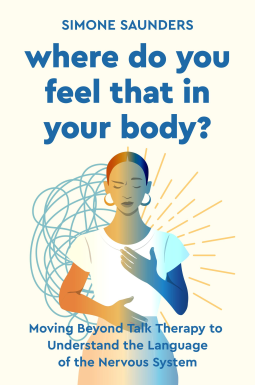
Publisher’s Summary:
For fans of The Body Keeps Score and How to Do the Work, trauma therapist Simone Saunders bridges the gap where talk therapy falls short—showing you how to move beyond self-awareness and reconnect with the sensations, signals and emotions your body has been shaped by, breaking cycles of emotional disconnection once and for all.
Many of us assume that once we understand why we feel the way we do, things will finally change. Traditional talk therapy often equips us with the language and self-awareness we’ve been missing — yet so many of us find ourselves stuck. We can recognize the trigger, name the pattern, and explain the story, yet still feel unable to create tangible change in our day-to-day lives. So, where’s the disconnect? What’s missing?
Registered social worker and trauma therapist Simone Saunders believes the answer lies in crossing the threshold from the mind into the body—moving from self-awareness into a felt, embodied understanding. In Where Do You Feel That in Your Body, Simone guides you through a gentle and practical approach to noticing what emotions feel like in your body, understanding the protective patterns shaped by identity and past experiences, and recognizing how your nervous system responds to stress and disconnection. You’ll learn how to read your body’s signals with curiosity, and how to build the capacity to stay present with your emotions instead of disconnecting from them.
In recent years, the language of the body—posture, facial expressions, movements, and sensations—has become more widely recognized for the integral role it plays in shaping and maintaining our survival patterns. Where Do You Feel That in Your Body shows you how to build a steady, supportive relationship with your nervous system that grows and shifts over time. You’ll understand how your body and mind communicate, how identity and culture shape your emotional responses, and how to gently shift the patterns that once helped you survive.
Review:
One of the best things about Simone Saunders approach to trauma-informed therapies is how accessible she makes learning about this complex topic. In Where Do You Feel That in Your Body?, Saunders uses the best references available in today’s field going back to Dr. Stephen Porges, Bessel Van der Kolk, Janina Fisher and Pat Ogden; up to today’s more inclusive educators and researchers from neuroscience and social studies. Saunders culminates all that reference material into one cohesive place.
In Where Do You Feel That in Your Body?, Saunders doesn’t focus on military personnel as some of the earliest work had to when studying what was then called shellshock. She focuses first on ACEs (adverse childhood experiences) and then works outward to logical events and circumstances that might affect how people end up in dysfunctioning autonomic nervous system responses including: poverty, racism, neurodiversity, gender identity, cultural expectations, natural disaster survivors, political instability, and inadequate access to healthcare. The most recent resource noted is from the Centers for Disease Control and Prevention (2025) but under the current leadership, a reader must take that for what it’s worth. Taking 1945-2024 data and summarizing it is a boon to people who are looking for material to get updated basic understandings of the science and psychology.
Saunders’ strong writing is sensible and presented clearly. When a term is introduced (such as neuroception, interoception, proprioception, and exteroception), she gives the definition again so readers don’t have to backtrack a word’s first appearance or bookmark a glossary.
There are three distinct parts of the book: Part 1 Understanding, Part 2 Connecting, and Part 3 Returning. Each of those consist of three to four chapters which end in bullet point notes. They include helpful tables that can be used as worksheets. She includes a diagram of the Window of Tolerance (hyperarousal, healthy coping zone, and hypoarousal) framework for readers who need the visual aid. Saunders has exercises after every chapter called Connect and Reflect. They’re intended to be personal experiments for the reader to explore themselves with the information just covered using compassionate curiosity rather than quick, harsh judgment.
The incorporation of neurodivergence is something that I hadn’t seen in my own reading and workshops I’ve attended. This umbrella term is comprised of such a wide array of identities and disorders that layman might never have considered. The way the word neurodivergent is bantered about today, it’s easy for someone on the outside to think it only includes the autism spectrum because the political debates about hoaxes and conspiracy theories. Saunders presents what it really means in a list from ADHD (attention deficit hyperactivity disorder) to dyslexia and more. She covers masking—what it is, why people have to do it, and giving readers the information to know when it’s safe to be authentic.
My only criticism of Saunders are her definitions of emotions and feelings. This is semantics. The words are explored in Chapter 8: Return to Feeling under Part 3: Returning section. She states:
Emotions are the body’s automatic responses, like a racing heart, jaw clenching, or a pit in your stomach. They’re driven by the nervous system and often happen before we’re even aware of them.
I agree with the second half. Emotions often happen before we’re aware. This is when we feel instant attraction to someone or that “Spidey sense” of danger ahead. I disagree that emotions are the body’s response. Emotions include sensations, yes, but there’s more and the key is that it’s separate from reasoning. The dictionary gives a different angle on it. Emotions are instinctive, deriving from one’s circumstances, mood, or relationship to others; intuitive feeling as distinguished from reasoning or knowledge. This comes from Kindle’s connection to the New Oxford American Dictionary.
Saunders disagrees with emotion and feeling being interchangeable. My argument is that it’s all about context and how the words are used. Feelings are an emotional state or reaction (the first definition listed under its use as a noun). Her definition of feelings is summarized at the end of her paragraph defining it:
So, in short, emotions arise in the body first, and feelings are how we interpret and carry them forward.
As the single thing I found worth debating, a reader can use their best judgment. It depends what they are seeking out this information for, whether they’re a therapist, someone looking for personal solutions, or a teacher. It doesn’t hinder the overall importance of this text.
Summary:
Simone Saunders’ Where Do You Feel That in Your Body? is a 2026 text that takes all the revolutionary work on trauma and the research behind it and presents that massive amount of data into easily digestible chapters and exercises. This is precisely the book to read if you want the information itself and can use the footnotes for the sources if you want to dive deeper into any specific area.

Rating: 5 stars
This review is provided as a courtesy from NetGalley.
 Founder and Editor-in-Chief of AmberUnmasked.com and Vodka O'Clock Podcast. Author of The Farrah Wethers Mysteries, comic book short stories, prose, and non-fiction. Cosplayer and figure model.