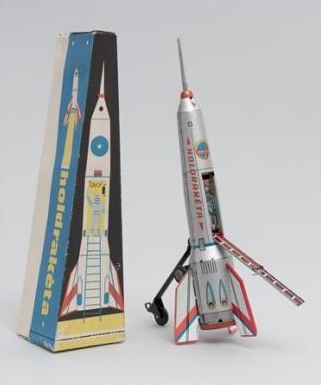
Amber Love 27-JULY-2012 Beginning this weekend the MUSEUM OF MODERN ART will exhibit “Century of the Child: Growing by Design 1900-2000,” a showcase of toys that are reflective of one hundred years of zeitgeist. This year, I’ve seen more consumers complain about the poor marketing of toys and cries for designers to expand gender neutral product lines in order to break the 20th century mold of girlie pink and boyish blue.
July 29-November 5, 2012 in the Tisch Gallery on the sixth floor, patrons can see a global impression of the how the world has changed through the eyes of the children and the designers that created toys. MOMA promises deep, at times emotional views of toys that were produced as the results of war, politics and harsh conditions.
REUTERS IMAGE 2012
“We’re showing the two-way, very dynamic relationship between new concepts of childhood and children and new ways of thinking about design process and creativity,” said Juliet Kichin, curator in MoMA’s architecture and design department.
Both children and artists share traits of openness and even disobedience, making them natural and empathetic collaborators.
Kichin said working for children “gave the avant-garde unique freedom and creativity.”
More than 500 objects from 20 countries, many from MOMA’s own collections, are included in the exhibit. Some items have never been seen before in the United States, including Scottish designer Jessie Marion King’s 1912-13 dollhouse made of painted wood and leather and her “Frog Prince” nursery panel. ~Reuters
The displays will stage everything you can imagine related to being a child and how items are designed for form and functionality.
“MoMA’s ambitious survey of 20th century design for children is the first large-scale overview of the modernist preoccupation with children and childhood as a paradigm for progressive design thinking. The exhibition will bring together areas underrepresented in design history and often considered separately, including school architecture, clothing, playgrounds, toys and games, children’s hospitals and safety equipment, nurseries, furniture, and books.
In 1900, Swedish design reformer and social theorist Ellen Key’s book Century of the Child presaged the 20th century as a period of intensified focus and progressive thinking regarding the rights, development, and well-being of children as interests of utmost importance to all society. Taking inspiration from Key—and looking back through the 20th century 100 years after her forecast—this exhibition will examine individual and collective visions for the material world of children, from utopian dreams for the “citizens of the future†to the dark realities of political conflict and exploitation. In this period children have been central to the concerns, ambitions, and activities of modern architects and designers both famous and unsung, and working specifically for children has often provided unique freedom and creativity to the avant-garde.”~MOMA.com
Founder and Editor-in-Chief of AmberUnmasked.com and Vodka O'Clock Podcast. Author of The Farrah Wethers Mysteries, comic book short stories, prose, and non-fiction. Cosplayer and figure model.
2026 (c) AmberUnmasked.com - Vodka O'Clock Podcast - Elizabeth Amber Love Privacy Policy
Cookie Consent
Feel free to Reject. I know I do. This site uses cookies to improve your experience on our site. By using this site, you consent to cookies.
Websites store cookies to enhance functionality and personalise your experience. You can manage your preferences, but blocking some cookies may impact site performance and services.
Essential cookies enable basic functions and are necessary for the proper function of the website.
Name
Description
Duration
Cookie Preferences
This cookie is used to store the user's cookie consent preferences.
30 days
These cookies are needed for adding comments on this website.
Name
Description
Duration
comment_author
Used to track the user across multiple sessions.
Session
comment_author_email
Used to track the user across multiple sessions.
Session
comment_author_url
Used to track the user across multiple sessions.
Session
These cookies are used for managing login functionality on this website.
Name
Description
Duration
wordpress_logged_in
Used to store logged-in users.
Persistent
wordpress_sec
Used to track the user across multiple sessions.
15 days
wordpress_test_cookie
Used to determine if cookies are enabled.
Session
Statistics cookies collect information anonymously. This information helps us understand how visitors use our website.
Google Analytics is a powerful tool that tracks and analyzes website traffic for informed marketing decisions.
Used to monitor number of Google Analytics server requests when using Google Tag Manager
1 minute
_gac_
Contains information related to marketing campaigns of the user. These are shared with Google AdWords / Google Ads when the Google Ads and Google Analytics accounts are linked together.
90 days
__utma
ID used to identify users and sessions
2 years after last activity
__utmt
Used to monitor number of Google Analytics server requests
10 minutes
__utmb
Used to distinguish new sessions and visits. This cookie is set when the GA.js javascript library is loaded and there is no existing __utmb cookie. The cookie is updated every time data is sent to the Google Analytics server.
30 minutes after last activity
__utmc
Used only with old Urchin versions of Google Analytics and not with GA.js. Was used to distinguish between new sessions and visits at the end of a session.
End of session (browser)
__utmz
Contains information about the traffic source or campaign that directed user to the website. The cookie is set when the GA.js javascript is loaded and updated when data is sent to the Google Anaytics server
6 months after last activity
__utmv
Contains custom information set by the web developer via the _setCustomVar method in Google Analytics. This cookie is updated every time new data is sent to the Google Analytics server.
2 years after last activity
__utmx
Used to determine whether a user is included in an A / B or Multivariate test.
18 months
_ga
ID used to identify users
2 years
_gali
Used by Google Analytics to determine which links on a page are being clicked
30 seconds
_ga_
ID used to identify users
2 years
_gid
ID used to identify users for 24 hours after last activity

 Amber Love 27-JULY-2012 Beginning this weekend the MUSEUM OF MODERN ART will exhibit “Century of the Child: Growing by Design 1900-2000,” a showcase of toys that are reflective of one hundred years of zeitgeist. This year, I’ve seen more consumers complain about the poor marketing of toys and cries for designers to expand gender neutral product lines in order to break the 20th century mold of girlie pink and boyish blue.
 Founder and Editor-in-Chief of AmberUnmasked.com and Vodka O'Clock Podcast. Author of The Farrah Wethers Mysteries, comic book short stories, prose, and non-fiction. Cosplayer and figure model.