
“Emotional Support Animals”
by Nicole J. Georges
Pub Date: 14-April-2026
Andrews McMeel Publishing
ISBN: 9781524899165
PRICE: $18.99 (USD)
PAGES: 160
Publisher’s Summary:
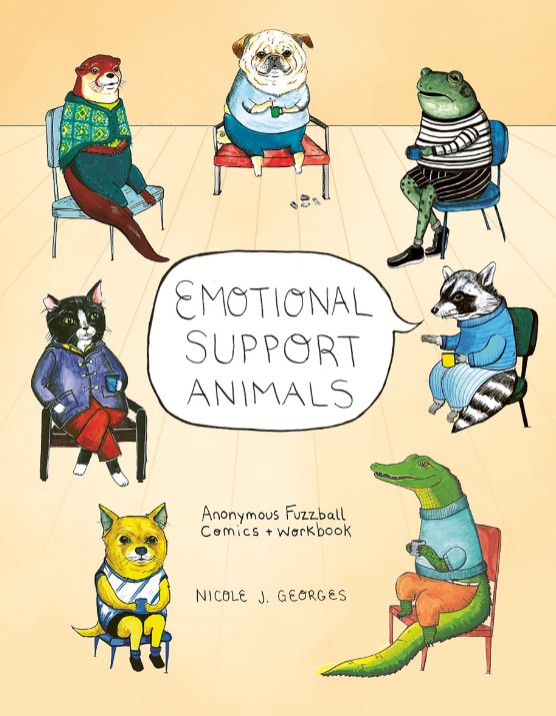
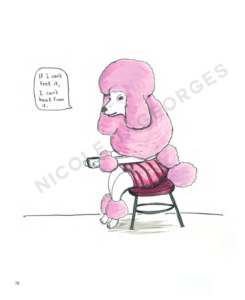
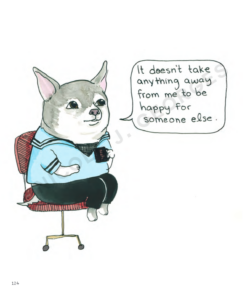
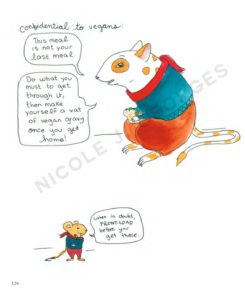
Emotional Support Animals is a collection of comics and worksheets featuring adorable and irresistible emotional support animals offering words of compassion and wisdom, delivering smiles along with experience, strength, and hope.
What if your therapist was a cardigan-wearing walrus sipping a cup of coffee? Emotional Support Animals answers this question in a series of sweet comics and engaging worksheets. Nicole Georges presents small doses of therapy in the form of humorous illustrations about serious subjects. Picture a pug assuring you that it’s not cruel to say no or hold a boundary, or a crocodile reminding you that when you take care of yourself, you have more capacity to give. Inspired by Nicole’s experiences with grief and healing, her Anonymous Fuzzball comics touch on themes of self-worth, boundaries, and balance. Using quirky animals as her subjects, she proves that hard truths are easier to digest in an adorable package.
Affirmations include:
“Just because someone’s having a big reaction doesn’t mean I did anything wrong.”
“You’re not going to mess up something that’s meant for you.”
“As I love myself more, I demand less of others.”
“What people say is just information. You don’t have to take it personally.”
“I don’t need to achieve anything to be lovable.”
Review:
This review is provided by NetGalley. I was intrigued immediately by the book’s cover and title not knowing anything about Nicole J. Georges‘ work before. It was the perfect book for a night when I my body was too tired to do much more than occasionally take a sip of water. It was only 4pm. What I needed was this book, EMOTIONAL SUPPORT ANIMALS, especially since my feline companion was not around.
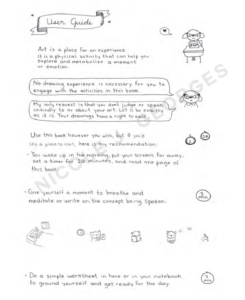
As I flipped through the introduction, I was surprised to find a User Guide. I thought, It’s a picture book. Why does it need a guide? There is a reason. This book asks you to do the work. Not just “work.” THE work. It’s a helpful assistant that invites readers to fill out worksheets the way a therapist might. The difference is, the instructions come from anthropomorphic animals wearing human clothing, drinking tea and coffee, and sitting in a circle for group therapy. They’re quite intelligent animals, too. They have important insights that can be read repeatedly anytime someone needs a reminder that they have choices, some control, love to give and receive, and deserve to set boundaries.
The lessons in these pages a secular with an air of teaching from Yoga and Buddhism. The first chapter is about exploring self love and self worth. Readers may have seen some of the affirmations a bit too often on social media, T-shirts, stickers, or heard them in a Yoga class. The point of an affirmation in a book like this is to focus on it. Take more time than the two seconds to read it and fully digest the message behind the words.
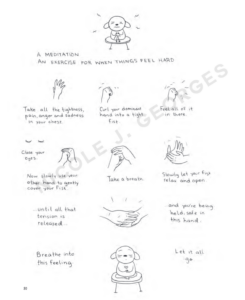
These words are not meant to coddle, though they are meant to make a reader feel better if they do the work. Everyone makes mistakes. The worksheets ask: What can you control? What’s out of your control? There are meditation guides after the worksheets. Georges works gratitude throughout the book via the worksheets, but there is a short chapter on it also.
There are powerful lessons in only a few words. You shouldn’t need to achieve something in order to be loved and feel supported. In the chapter about other people, Georges has the animals remind readers that they can’t control what other people think of them. Some relationships are not worth the toll to save. This section leads into the next about setting boundaries. A couple of the important questions here are: What am I willing to do for others? What am I not willing to do for others?
After relationships and boundaries, readers are invited to reflect on grief and loss. There are reminders that the heartbreaking pain is a temporary moment (even if long). People don’t process any of these big emotions the exact same way. If someone has held onto resentment for years, trying to then process the loss of who that represented could be a complicated journey through a myriad of emotions.
Communication is not always easy. We can blame technology, but to be honest, people have been terrible at clearly communicating with each other forever. Georges’ animals remind readers about the importance of listening rather than formulating responses. This chapter educates readers about the effects of childhood. People might not have been given the language to talk through their experiences. They might not have had support much or at all. They may have seen violence as the response to anything.
The chapter on fear and anxiety are as impactful as the one on grief. Without going into the science of a trauma cycle and the nervous system which readers don’t necessarily want, Georges’ support animals tell readers that they are not under fire all the time. Their bodies might not realize it’s appropriate to deeply breathe and let go of the ingrained habit of hyperawareness.
The workbook and support animals continue by moving readers through other obstacles like jealousy, setting goals (intentions), and dealing with family on the holidays. It ends with a heavy chapter calling readers to action. When we are overwhelmed by the global state (news, wars, terrorism, climate change, animal and plant extinction), it’s possible to feel like there’s nothing one person can do. Georges gives worksheets about making a plan to take an active role.
Summary:
Through cartoon animals in a group therapy session, Nicole J. Georges invites readers to map their feelings, responses, communication styles, and setting boundaries. The worksheets give practical hands-on ways to pause and self-reflect. Do you act out in anger? Do you run away? Are you always saying yes to others when you need time for yourself? This charming animals are filled with their own personalities and are meant to challenge readers. Looking at oneself is not always fun. It’s not supposed to be. It’s work. Anyone can use these tools for bettering themselves and then teach them (to their kids, partners, friends).

Rating: 5 stars
Preview:
 Founder and Editor-in-Chief of AmberUnmasked.com and Vodka O'Clock Podcast. Author of The Farrah Wethers Mysteries, comic book short stories, prose, and non-fiction. Cosplayer and figure model.