
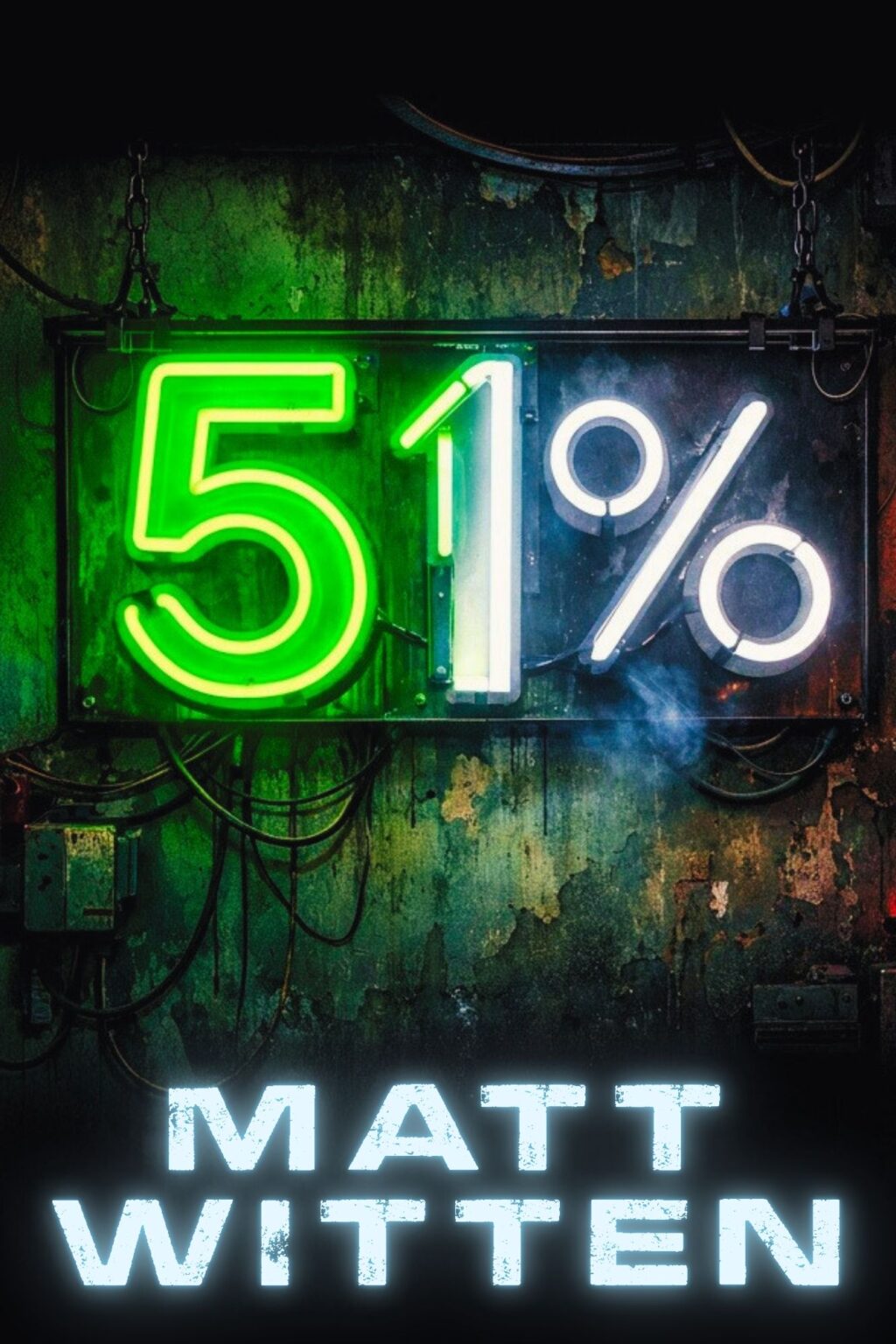
Book Review & Analysis: “51%”
Matt Witten
Level Best Books
pub date: 28-April-2026
Publisher’s Summary:
In a future where corporations own everything—including people—one murder could ignite a revolution.
Twenty years from now, the United States is completely privatized. The Big Six syndicates own schools, roads, police departments…even human beings.
When a young immigrant woman—51% owned by the syndicates—is brutally murdered, NYPD, Inc. Detective Juke O’Keefe and his partner, Crime Marketing Consultant Haylee Navarro, catch the case. Pregnant and broke, Haylee knows they can’t crowdfund enough from a dead immigrant to pay for basic forensics, let alone their paychecks. But Juke, with his old-school sense of justice, is determined to find the killer.
Their search for the truth leads them to Juke’s ex, Safiya Jones, a Resistance leader on the syndicates’ most wanted list. As the three join forces, they stumble onto a conspiracy designed to destroy the last shreds of American freedom. To rescue fifty-one percenters—and everyone else—from syndicate control, they’ll have to defeat the most ruthless, powerful AI in the world.
51% is a gritty, fast-paced thriller about power, justice, and what happens when everything—even people—can be owned.
Review and Analysis:
Trigger Warnings: gun violence, sex trafficking, oppression, no autonomy, poverty
As you open the pages of Matt Witten’s 51%, you’ll hear Movie Trailer Guy’s voice: “In a world where six conglomerates rule 80% of the economy, the government and the people answer only to those syndicates. Unless you are debt-free, some part of your life is owned. Indentured. Detective Juke O’Keefe needs to solve the murder of a woman who was 51% owned no matter who ends up as his suspect.”
The Story
Police work is crowdfunded so every case gets a Crime Marketing Consultant, someone to make posts and build up the funds hoping to get a top viral spot. Investigators have to beg for advances if they want any forensics done or search warrants. There’s no body armor, at least not in New York City. Up in Canada, things are different for law enforcement as well as the citizens. Canada means freedom.
In this future United States, there’s no public education. Parents go deep into debt giving up their own autonomy to syndicates in order to get their fetuses enhanced, a process considered crucial for them being smarter and having a better life. Forget about healthcare. To get that, one has to sign themselves away to enslavement. People don’t get to keep their jobs and make their own decisions unless they stay below the majority threshold, 51% owned.
If a woman is majority-owned by a syndicate, she’ll most likely be sex trafficked. That is what happened to the victim of Witten’s story. Not a spoiler as it’s the principle theory of the murder investigation. It becomes clear where the victim’s story is headed. Talia Qirimoglu did her best to make a life in this cyber-noir world. All it took was a medical need for her to end up 51% owned. Her intelligence didn’t matter. Nothing about her life mattered to her syndicate. No one’s skills actually matter unless the New York AI mind, “the Red Queen,” deems them a threat using a ten-point scale. Talia wasn’t a threat, but one of our heroes was.
Characters
Juke O’Keefe: Drinks too much and still in love with his ex-girlfriend, Safiya who is the leader of the citizens rebellion his murder case is connected to. Juke meets the criteria of any noir detective regardless of the time period. Juke has incredible compassion under that brusque personality. He reminded me of Harry Bosch. They have similar mottos. Bosch’s is based on a real detective author Michael Connelly used as inspiration. Everybody counts or nobody counts. Witten’s hero cop, Juke, has the mantra, No victim too small.
Haylee Navarro: The Crime Marketing Consultant for Juke. She’s working a job she hates and assigned to a cop who doesn’t care about making money. Haylee plays a major role as a hero with a motivation defined by page two. She’s pregnant and the father of her child died tragically in a way that the trauma has given her PTSD where she freezes at moments of danger. While Juke may appear to be the main character, in a way, it’s Haylee. She’s the one with the most to lose out of the two of them. She goes through some key advancements of the Hero’s Journey. She has the most character development in 51%.
Safiya Bassani-Jones: She’s more than Juke’s ex-girlfriend/damsel in distress. She’s a badass biracial woman who has devoted her life to helping others. She loves to saves cats too. Witten makes these character traits more than color commentary. Her dedication to all living beings plays a critical role in the plot.
Karolyn Ford: The sexy face of authority most her male colleagues want to have sex with other than listen to. Her motivation is to make her syndicate happy and rise through the ranks. Karolyn is not the “Big Bad” of the story, but she is the primary antagonist. Though she works for the Syndicate Agency of Public Safety (descended from the CIA), not the police, she can issue the orders through the chain of command and to have her bidding done. Karolyn’s interest is not in the murder investigation of a poor immigrant. She needs to put an end to any “Sed Red” (Seditious Red Alert) activity.
Warnings About Technology and Privatization
Witten addresses technology and capitalism in interesting ways for his dystopian future. Most people can find a gun. It’s practically expected for survival. Microchips are commonly embedded in citizens. Whether a person works for the syndicates or owes them money, they’ll have a traceable chip to make sure they never escape the United States.
Anyone who tries to remove their chip sets off a backup system called a bio alarm. Something like nanobots are sent into the bloodstream signaling their particular syndicate. Even without a bio-alarm, the AI can have all your information: GPS, heart rate, emotions, bodily functions—pretty much anything happening to a person can be parsed by their syndicate’s AI.
In this future, the cars are not exclusively operated without humans. The self-driving modes can be turned off. However, only valid law enforcement can overwrite the operations to go over the speed limit or commit any violations.
Modern and future-set stories have to include ways for characters to maneuver around the constant surveillance. It’s challenging to have a scene beat constructed of anything more interesting than a cell phone battery dying. Witten leaned into hacking (something I always loved in crime shows like Leverage and Criminal Minds). People have figured out how to use voice changers and always have access to burner phones. Hacking skills are the heavy duty weapons of the resistance against the authorities. Yet, no spoiler here, Witten invented nearly tech-free solutions to give the resistance its biggest break.
Climate Change
In Witten’s New York City, no one has seen the moon or stars for years. The sky is intentionally blocked by syndicates who flood spaces with holograms. Don’t expect to vacation in a National Park for some of that either. One might be allowed to see the sky, but syndicates run the parks so it’ll cost a lot of money. Besides parks, syndicates own all the resources like water—much the way companies like Nestlé, Coca-Cola, and PepsiCo do today.
The pollution is measured by meters giving New Yorkers an idea of whether or not they should wear an anti-pollution mask. Much like living through the COVID-19 pandemic, people pro-mask used them not only for protection about airborne particles, but also figured out how to make them fashionable. With AI everywhere, donning a mask also protects people from the constant scans for facial recognition. When citizens gather to protest, their identities need to be secure.
My last note of this society is about meat. People don’t eat the kind of meat available today. It’s bugs. The meat packing district becomes the bug district.
Future Language and Vernacular
Take a look at some of the creative ways Witten updated language:
- The NYPD is now the NYPDinc and owned by a syndicate, of course. Cops are called Dincs and likewise FBI agents are called Fincs.
- O’Keefe’s patrol car is called a Zan. In fact, the cars and ride share drivers have slang that’s easy to follow. Ride share is oob or oober.
- Protests=flares.
- Homeless/Unhoused=homefree. This term is particularly interesting because it can be broken down to “free of a home to live in,” but within Witten’s story, the owned citizens would do anything to be home free in the way we use the phrase today in 2026.
- Thousand dollar bills=Reagans
- Paying/payments=ka-ching
- Computer=Hodu
- Apartments=specks
- Internet=networld
- Dude=doob
- Shoot/kill=zap
- Resistance=Rez
- LGBTQIA=Rainbow or non-trads in a homophobic society
- Neighborhoods and streets are renamed with cringeworthy nods to right-wing, conservative, and radical capitalists. Gun brands are parodies as well (except for the classic Smith & Wesson). There are brands like Heston and Ruby Ridge used by authorities; and a Joe Hill used by a member of the rebellion.
Summary:
Matt Witten’s 51% is a fast-paced cyber-noir where three factions are intertwined in a single 24 hours of time throughout the entire book. Readers will be indulged in the relationships that play on partner/sidekick, former lovers, citizen versus local law enforcement, citizens versus global corporations, and everyone versus technology.
Whether retailers, readers, and the publisher classify this as cyber-punk, neo-noir, tech-noir, cyber-noir or even sci-fi, there’s a race-against-time plot pitting three sides against each other.
51% is for fans of The Warehouse by Rob Hart, The Murderbot Diaries by Martha Wells, and Robocop. Basically, anyone who loves rebellion against oppression stories will appreciate it. The story is fueled with the pastiche of Blade Runner and The Terminator. Overall, 51% is a satisfying reading experience with a hopeful ending.
If you are intrigued by the premise and plot of 51%, it has been optioned as a TV series. Maybe something will happen. A show holding a mirror up to capitalism, climate change, and technology might not fly with the executives.
Rating: 5 out of 5

This review was possible with access from NetGalley and the author.
 Founder and Editor-in-Chief of AmberUnmasked.com and Vodka O'Clock Podcast. Author of The Farrah Wethers Mysteries, comic book short stories, prose, and non-fiction. Cosplayer and figure model.