
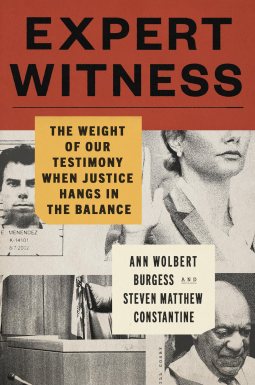
Expert Witness:
The Weight of Our Testimony When Justice Hangs in the Balance
Ann Wolbert Burgess and Steven Matthew Constantine
Grand Central Publishing
pub date: 02-Sept-2025
**Trigger Warnings: violent crimes including sexual assault, murder, child SA**
Publisher’s Summary:
From the author of the critically-acclaimed true crime account, A Killer By Design (the inspiration behind Hulu’s original docuseries, Mastermind), a groundbreaking look into the crucial role played by expert witnesses in the most high-profile criminal cases, based on Dr. Ann Burgess’ personal experiences within the criminal justice system.
Written through Burgess’ singular lens of compassion and lived experience, Expert Witness pulls back the curtain on some of the biggest cases in the last thirty years—from Bill Cosby to the Menendez brothers to Larry Nassar—to reveal the deeply human stories behind the trials that have captivated a nation. The book explores the role of expert witnesses in high stakes court cases, offering first-hand accounts and never-before-seen interviews with attorneys, victims, and offenders.
Expert Witness places readers inside the mind of the nation’s most prominent courtroom expert, following Burgess as she takes on one seismic case after the next. Throughout the narrative, each case deepens the reader’s understanding of the art and science of expert testimony, taking readers from the women’s movement of the 1970s to the #MeToo movement of today—one of the largest social reckonings in recent history. At its core, Expert Witness is a story of empowerment. It’s a story of compassion and the ever-increasing need for individuals to stand up and speak truth to power or to popular opinion. And it’s ultimately a story of how revolutionary one voice can be.
Review:
I have a feeling I’m the only person in my social circles that has a favorite criminal investigator. Although, I suppose, if true crime fans listen to podcasts or read non-fiction, they may choose an investigator-turned-celebrity like Paul Holes. For me, Dr. Ann Wolbert Burgess is a pinnacle of the field. She continues to rock the world of justice at age 88 and also remains at the top of my list for as a pioneer, public speaker, feminist, data researcher, and author. EXPERT WITNESS is her second book with co-author Steven Matthew Costantine. The first was A Killer by Design: Murders, Mindhunters, and My Quest to Decipher the Criminal Mind.
Pros:
EXPERT WITNESS is exceptionally well-organized and easy to read despite the severity of the subject matter. It includes an introduction, ten chapters, and an epilogue. The introduction and epilogue are, honestly, chapters in their own right. They aren’t exactly short and each presents a topic that Burgess and Constantine explore with headline examples. The chapters take on a handful of specific criminal and civil cases where Burgess took on the role of an expert witness. Not all of them required her to take the witness stand, though she was always prepared for it.
The introduction gives a history lesson of how the American court system created expert witnesses and laid out the credentials required. American judicial history, of course, spurred from the English (without those wigs). Needless to say, 18th century to present day scientists called to the witness stand can and do have biases, even though they should not. For a basic understanding of the landmark cases, Frye v. United States (1923) and Daubert v. Merrell Dow (1993) and the Federal Rules of Evidence, readers will appreciate the beginning of the book.
The first chapter is an example of what Burgess’ research was like for a great deal of her career. She took on Jane’s case in the early 1970s. Jane was the victim of a home invasion and sexual assault by three men. What’s crucially addressed in this chapter and others is that cases of rape (which legally may be divided into other labels) are so rarely brought to trial [1]. The cases Burgess and Constantine chose to include in EXPERT WITNESS illustrates how badly victims are treated by law enforcement, lawyers, judges, juries, the press, and the public. What’s impressive is that by chapter ten, some of these heinous behaviors are changing as the growth and change occur in society. For Burgess to bear witness to these changes within one lifetime is remarkable.
Chapters 2-4 are about the work Burgess did on the defense for Erik Menendez, one of the two infamous Mendendez brothers who murdered their parents. People in Burgess’ sphere were shocked that she was going to defend a male killer given her historic path of helping female victims of violence by men. She was only allowed to work on one of the brothers’ cases. This look at her approach, what happened in court, and then what couldn’t happen during the second trial show how frustrating the judicial process is.
The Con-Man. It’s a character who has been romanticized throughout time in stories. Burgess calls them out for what they are: liars and manipulators out for their own gain. Chapter 5 is an important highlight in Burgess’ career. She categorized Charlie Scott as a confidence-style rapist. The reason this case is well-chosen for a book about expert scientific witnesses is that psychology and psychiatry can be disparaged in discussions about science. There are valid reason which aren’t for a book review. Burgess blossomed into the pioneering advocate for victims of violence because of her years as a psychiatriatic nurse who interviewed and treated those victims.
What is a confidence-style rapist? These are offenders that will manufacture relationships with their targets. As a friend or acquaintance, this type of offender gaslights their victims into questioning whether the assaults were consensual sex. Casting that doubt is all it takes for uncertainty to take hold. Victims blame themselves.
Erik Menendez wasn’t the only case where Burgess’ expertise was sought out to defend a man. Burgess’ feminism has always revolved around helping victims regardless of demographic. She carved the methods to analyze and find patterns of (at the time, all male) serial violent criminals.
Chapter 6 might be a difficult case for some readers to appreciate (as I feel about the epilogue). The Duke University case of lacrosse players falsely accused of beating and raping a female dancer they hired for entertainment was one of the most polarizing of examples of collegiate elites versus someone of a less glamorous status. Burgess agreed to help on the defense of Reade Seligmann, at the time a 19-year-old student and one of the three accused athletes. The reasons become crystal clear in this chapter why Burgess was willing to take on the case. She and Constantine clearly present the evidence and the unreliable narrative of the accuser.
Before going into what I felt were the best chapters in EXPERT WITNESS, there’s chapter 9, “Kemper Revisited.” This chapter is unlike any of the others. Kemper has been in prison for a long time. He has never denied his crimes although he sometimes lies. He’s also famous for being the first serial killer the FBI decided to use in order to invent the entire field of profiling. This chapter shows Burgess’ point of view when she was contacted by Gregory Horoupian in 2018. There’s a lot of inaccurate information about Kemper and his crimes which is why Horoupian went to Burgess. He wanted to go back to the primary sources including Burgess and Kemper to get the stories right. None of the graphic details of those crimes are included. This unique chapter is truthful look behind the scenes yet away from the filthy trenches of a serial killer’s mind (for that read the other book by Burgess and Constantine).
The heaviest hitters in EXPERT WITNESS are chapters 7, 8, and 10. These show Burgess’ involvement with one victim of Bill Cosby and one victim of Larry Nassar. The two cases are even larger in impact, spectacle, and sensationlism than the Menendez case.
Andrea Constand suffered from delayed onset posttraumatic stress disorder as determined by Burgess. This was necessary to show that Constand was, in fact, effected to this day by Cosby’s assault. Burgess administered a psychiatric examination, came to understand Constand’s mental state, and saw what elements of the present day are clouded by the trauma. Cosby was bold enough to try it again when Constand went to his house a second time with the plan to confront him.
Details like Constand’s loose-fitting, inconspicuous wardrobe choices of 2016 show how Constantine plucked signs of depression from Burgess’ input. This survivor resigned from her job and moved back in with her parents. She lost weight, another sign. Perhaps the saddest for her was when she lost her interest in sports. The whole reason she went to see Cosby was because she sought his mentoring to get a job in sports journalism. The shame and embarrassment are palpable in each paragraph. Cosby’s grotesque actions are spelled out in detail. It’s Constand’s play-by-play descriptions including her assailant’s flippant side of their conversations that will make any former Cosby fan feel like they’ve been punched in the gut.
Larry Nassar, convicted sex offender, has had over 500 known victims, according to chapter 10, “Victim Impact Statements.” When Burgess became involved in the case, there were 150 victims who had come forward. This chapter’s title clearly illustrates one key part of a modern case. The prosecution brought Burgess on board for the exam and analysis of the victim called M. in EXPERT WITNESS. Burgess set out to show M. that, in this tsunami of survivors, she was going to be more than a data point. The goal was for M. to feel seen, heard, and acknowledged by an impartial person. Like the Cosby chapters, chapter 10 includes the details of what M. went through at the hands of Nassar, and subsequently, her personal aftermath.
Cons:
The epilogue is more than a mere summation of Burgess’ thoughts on the role of the expert witness in today’s American judicial system. Burgess jumps into the deep end in defense of artificial intelligence. Knowing that AI is not only responsible for consuming natural resources beyond measure, and that AI is not a fact-checked source [2], makes any defense of LLMs unbearable.
I will point out that Burgess, unlike people stealing art, speaks about her excitement for a tool where investigators can feed their written reports and have those analyzed to find patterns and allow humans opportunities to use their time more productively. Personally, I don’t think that will happen, but I’m not an expert. Burgess believes AI will produce indisputable facts without bias.
People better versed than I could ever be on AI have worked through the various systems and come across its failures. These LLMs have been proven to exhibit bias in favor of white, heteronormative, conservative-thinking males. It’s a running joke how quickly they turn against humanity’s best interests.
Summary:
EXPERT WITNESS is a quick way to get an authentic look into the world of being a scientific expert and advocate for victims of violent crimes. From the 1970s to present day, Dr. Ann Wolbert Burgess has had a fascinating perspective about the aftermath of such crimes which she graciously shares with the world. Steven M. Constantine co-authors Burgess’ decades of experience in a digestable format with well-organized chapters. The stories include transcripted conversations and court records while still adding the flourishing touches of what Burgess was thinking, the setting, and what she gleaned from those involved in each case.
Burgess’ opinion of AI is hopeful and clearly comes from a place of passion in crime solving and proving. This is a divisive topic. The viewpoint that AI will solve, rather than cause, problems is something that has yet to become a proven fact. The naciency of the technology has a long way to go before law enforcement—no less civilians—should rely on it for unbiased and factual output.
Being analytical does not mean without empathy, compassion, and concern. Burgess bears the weight of the burdens people entrust to her to see that justice is done.

Rating: 4.5 out of 5 stars
Notes:
Only 2-5% of sexual assault caes make it to trial.
Articles on AI:
Krishnamohan, A. (2025) Why ai fails: The untold truths behind 2025’s biggest Tech letdowns, Techfunnel. Available at: https://www.techfunnel.com/fintech/ft-latest/why-ai-fails-2025-lessons/ (Accessed: 04 August 2025).
Wu, D. (2025) Lawyers using AI keep citing fake cases in court. judges aren’t happy., The Washington Post. Available at: https://www.washingtonpost.com/nation/2025/06/03/attorneys-court-ai-hallucinations-judges/ (Accessed: 04 August 2025).
Courts across the country are facing a deluge of filings from attorneys and litigants that back their arguments with nonexistent research hallucinated by generative artificial intelligence, prompting judges to fight back with fines and reprimands.
The problem reflects well-known issues with AI tools, which are prone to fabricate facts, or in these cases, citations. Soon after AI tools such as ChatGPT began to circulate, attorneys made headlines for submitting error-ridden memos after failing to check AI-assisted work.
 Founder and Editor-in-Chief of AmberUnmasked.com and Vodka O'Clock Podcast. Author of The Farrah Wethers Mysteries, comic book short stories, prose, and non-fiction. Cosplayer and figure model.